
How Guizhou’s nail-less towers and songs resonate in the Cordillera
(First of two parts)
Text and Photos by: Lita Jane Botigan-Cadalig
When you step into the Zhaoxing Dong Village in China’s Guizhou Province, the first things you will notice are the drum towers. To the uninitiated, these pagodas are merely remnants of an ancient civilization. But if you look closer, you will find not only an architectural wonder, but also the profound significance of these structures to the ethnic minorities.

For the Dong people; the drum tower, built without a single nail, is the center of their social and daily life. Construction of the towers relied on interlocking mortise-and-tenon joints, a technique where the carpenter carves the woods or timber so that they fit together when joined. The builders did not have any blueprints or plans. They simply relied on their memory and experience.
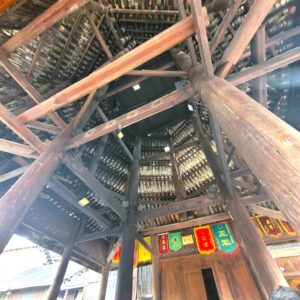
For a Cordilleran traveler, the Dong drum tower feels familiar: built like the traditional Igorot houses that did not use any metal to connect parts, it uses an instrument to summon people, and functions as a venue for community decision-making.
Just like the elders (amam-a) who convene in the Cordillera dap-ay or ato, Dong elders used to gather around the drum tower’s fireplace to come up with decisions, settle local disputes, or deliberate on punishments for those who violated village rules.
In the olden times, the towers were not public properties, although they were venues for communal affairs.
“Each tower belongs to separate family clans who built and maintained them,” said Xiao Ze Sheng, the tour guide who accompanied a visiting media delegation in Guizhou.
Xiao added the number of drum towers in a Dong settlement indicates how many major families or clans live in that community.
In Zhaoxing, five drum towers are spread across the village.
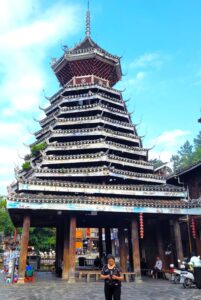
The drum, which is located at the upper floor of the towers served as the community’s alarm system, similar to the gangsa, which was beaten to signal incoming enemies, emergencies, or to summon villagers to gather for verdicts or announcements.
These days, the Dong drum and the Cordillera gong are no longer used as an alarm system. The beating of these instruments now signals major celebrations, such as festivals and other community gatherings.
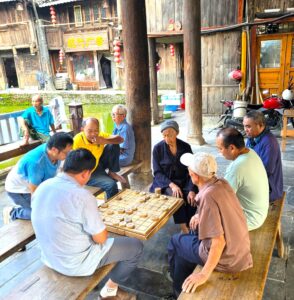
Today, the Dong towers no longer actively function as venues for conflict resolutions or community decisions, but they remain as places for socialization where elders still gather to play Chinese chess, among other activities.
The public squares in front of these towers serve as venues for cultural performances, such as the Dong Grand Song or Dong Chorus, a UNESCO-inscribed Intangible Cultural Heritage.
The Dong Chorus also shares a resonance with the chants of the Cordillera, such as the Ifugao Hudhud, the Benguet badiw, and the salidummay.
Performed a cappella, the Dong Grand Song follows a leader-chorus format. Depending on the context, a member delivers either a strictly memorized line or a spontaneous one followed by a chorus by the rest of the performers.
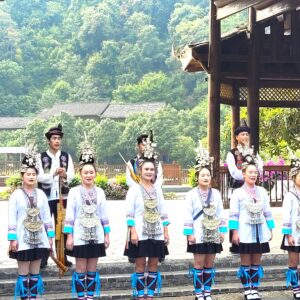
Much like the Cordillera chants, the Dong Chorus is also bound to the agricultural cycle, is sung for courtships, or simply performed to welcome guests.
Like the construction of the drum towers, the Dong Grand Song does not have a musical sheet. It is passed down to the next generation through oral tradition.
A part of the Dong Chorus mimics the sound of a cuckoo, which dictates the start of the agricultural calendar.
“When the cuckoo bird starts singing, it’s time to plow the fields,” Xiao said.
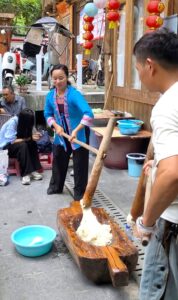
The Dong people cultivate glutinous rice, which they pound using wooden mortar and mallets to become chewy rice cakes.
Zhaoxing is the largest Dong minority settlement in China. Its historical preservation and cultural significance made it one of Guizhou’s tourist destinations.


Zhaoxing Dong Minority Village is two hours by high-speed train from Guizhou’s capital city of Guiyang. Before the completion of the high-speed rail systems and major expressways, travel to the village took seven to 10 hours.


