
Lina Espina – Moore : Affectionate Subconscious Eye on the Locale
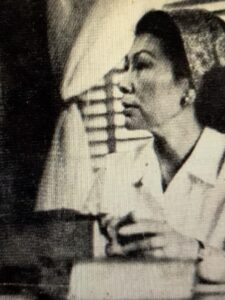
Lina Espina Moore, the writer, in her early years as depicted in Cecilia Brainard’s website.
By: Nonnette C. Bennett
Fiction at its best is reality renamed.
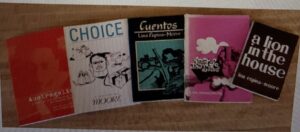
CUENTOS-is-among-the-five-books-written-by-Moore-which-has-stories-of-Baguio-City-and-life-in-the-mountains-scaled.
Lina Espina – Moore (a native of Cebu) who married American sawmill manager Climpson Moore in 1960 lived near Mt. Data along Halsema Highway (formerly Mt. Trail). In the 17 years that she lived with the Ibalois and Kankanais she learned the nuances of the culture and found some details interesting enough to write about in her short stories. Long before gender equality, Austregelina (her birth name) depicted the qualities of strong women in her characters. This gained her recognition in the 1980s as a Filipino Writer in English and in the 90s – 2000s as a feminist.
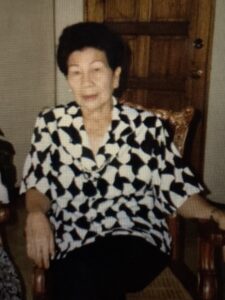
Lina-Espina-Moore-in-2020-in-Cebu-as-taken-by-Cecilia-Brainard.
Her biography says that she wrote about tribal minorities. On this note, “Cuentos: An Anthology of Short Stories” by New Day Publishers, 1985, best describes Espina – Moore’s insights into the culture in some stories of the collection. Her female characters express how the cultural practices affect a woman’s identity and the qualities appropriated for her.
Simeon Dumdum, Jr. in the Foreword aptly describes the contents, “affectionate subconscious eye on these locales” and “women who are free but not that free; women deeply in love; loved in return but can make no claim on the lover.”
Living in K.M. 102, Lina married Kip in 1960. At this time, Americans played key roles in the management of the mines and his role was to provide the lumber to support the stopes in the mines and for the construction of residences from the mountains of Bokod, Benguet. Logs were transported via trams to the Heald Lumber Sawmills located in Bauko, Mt. Province. This place is busy on the roadside but quiet where the trees still lined the paths into the mountains.
In 1956, K.M. 102 was a favorite stop-over enroute to Sagada, Mt. Province and a stone’s throw away from the Mt. Data Lodge. Mrs. Cecile Afable of the Baguio Midland Courier often mentioned a stop-over at Kip Moore’s place. He was a generous supporter to the Baguio newspaper with his generous greetings in occasions, particularly the 10th anniversary. Cecile was the sister of Oseo Hamada, the publisher, and Sinai Hamada, the editor – in – chief of the local newspaper. She took charge of the lifestyle page and wrote a column called “In and Out of Baguio” until her death on June 12, 2012.
A favorite past time was cockfights at that time and Mrs. Afable took special notice of the cocks that greeted her at the home of the absent Kip Moore. This connotes that the home was a destination of many travelers and also a host of some parties for American and Filipinos of nearby Mankayan and Baguio some 75 kms away.
Many Americans at the time married native-born Filipinas or others born in other places. Before marrying Moore, Lina was a reporter for Manila Times when she graduated from Far Eastern University. She had already published several stories in Graphic Magazine and the Sunday Times when she came to Baguio City. She was also among the first members of the Philippine Association of Women Writers (PAWW) in 1950 before she decided to write in Cebuano under Liwayway Publications. Perhaps, it was Kip’s story-telling that captured Lina’s attention because she was quoted in her book “Cuentos” to have described him as, “Kip Moore, American, who perhaps after his Irish forebears, was a no mean story-teller himself.” She says that her story-telling abilities were inherited from a father who filled her life with stories too.
Sometime in 1963, Mrs. Afable writes about an encounter with Lina Moore at the Mt. Data home. Afable said that Lina said she saw the natives dance gracefully to the tune of “Blue Moon”. Mrs. Afable did not flatter Lina and her limited knowledge of the natives.
Unknown to Mrs. Afable, Lina would write three short stories about the beliefs and customs of the Ifugaos, Ibalois and the Kankanais with reverence and fondness. In the short story “Pieces of Silver”, she compares a member of the Ifugao tribe to Judas who sells heirlooms and “Bulols” (figurines) for money unmindful of the purpose of these items to the bounty from the watchful forebears.
Moore’s works like other stories speak about lifeways in these parts of the country.


